

Early Powdery Mildew Control: Using Growing Degree Days to Stay Ahead of the Disease
Updated: Aug 31
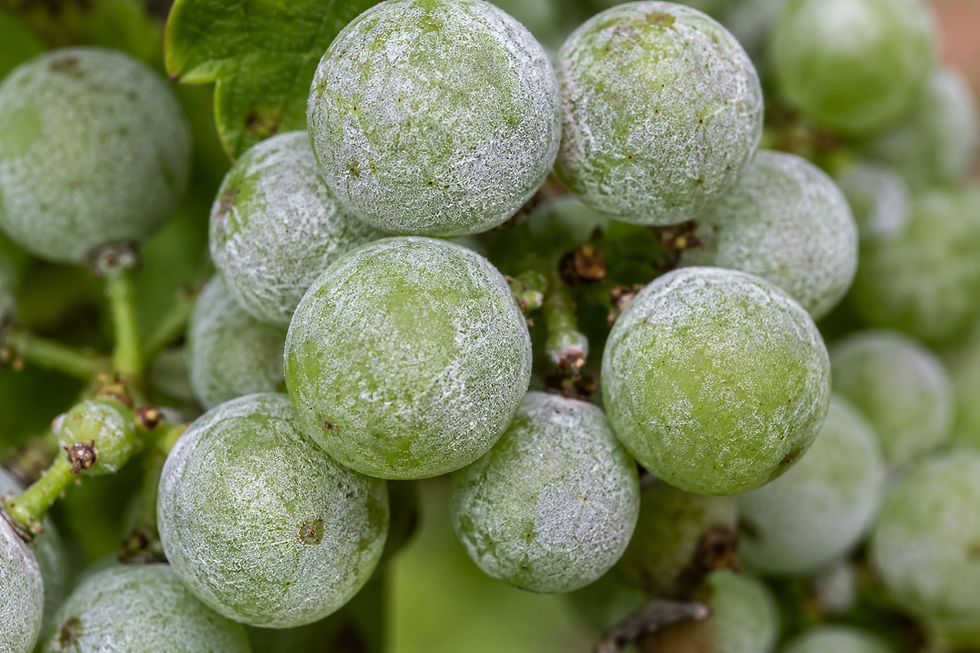
Powdery mildew is one of the most persistent diseases confronting wine grape growers. Caused by Erysiphe necator, the disease can infect leaves, shoots, inflorescences and berries, with infections established early in the season capable of developing into significant disease pressure around flowering and fruit set.
The challenge with powdery mildew is that by the time it becomes obvious in the vineyard, the grower may already be behind.
This is why early-season control is so important.
The Australian Wine Research Institute describes the period from just after budburst through to flowering as a critical period for powdery mildew management. Early infections establish the inoculum that drives the epidemic later in the season, making prevention during the early stages considerably more effective than attempting to control an established outbreak. (AWRI)
The disease can start before you see it
Erysiphe necator can survive between seasons in two principal forms: infected buds and chasmothecia, the small resting structures that can survive on vine material.
Infected buds can produce what are commonly known as “flag shoots” after budburst. These shoots can become heavily colonised and produce large quantities of conidia that spread to surrounding green tissue.
Chasmothecia provide another source of primary inoculum. Under suitable conditions, they release ascospores which can infect young leaves.
This means a vineyard can have active powdery mildew inoculum before there is enough visible disease for conventional scouting to detect easily.
Research conducted in Australia has demonstrated the importance of controlling this early inoculum. The concept has been described as “lag-phase control”—keeping disease incidence low during the early part of the epidemic so that the rapid increase in disease severity later in the season is prevented or substantially reduced. (Wine Australia)
Why the first 40 days matter
Wine Australia’s powdery mildew information identifies the first approximately 40 days following budburst as an important period for control because young basal tissues are particularly susceptible and infections established during this period can contribute to the development of flag shoots and subsequent inoculum. (Wine Australia)
The significance of this period is that the grower is attempting to control a relatively small amount of inoculum before it has had the opportunity to multiply.
Once secondary infections begin producing conidia, the disease can move through the vineyard much more rapidly.
The Australian Wine Research Institute similarly states that season-long control depends upon reducing early-season inoculum and that treatment needs to begin promptly when risk is present. (UC IPM)
This creates an important distinction between disease control and disease rescue.
A preventative program protects clean tissue before infection becomes established. A reactive program attempts to deal with an epidemic that is already developing.
For premium wine production, prevention is generally the better strategy.
Where do growing degree days fit?
Growing degree days, or GDD, provide another way of looking at disease development.
Instead of simply using calendar dates, GDD measures accumulated temperature and therefore provides an indication of how quickly biological processes are progressing.
Grapevines themselves respond strongly to accumulated thermal time, which is why GDD is commonly used to track vine development. Disease organisms also respond to temperature, meaning thermal accumulation can provide useful information about the timing of infection and inoculum development.
Research by Carisse and colleagues developed and validated a degree-day model specifically for grape powdery mildew. The model used accumulated degree days above a 6°C base temperature, beginning at Eichhorn-Lorenz stage 7, corresponding approximately to two to three fully expanded leaves. The model explained 91% of the variation in the proportion of seasonal airborne inoculum and 96% when validated against independent observations. (ResearchGate)
Importantly, the researchers demonstrated that using the degree-day model to initiate fungicide programs could reduce the number of fungicide applications by approximately 40–55%, depending on the season and cultivar, while maintaining disease management. (Taylor & Francis Online)
That is a significant finding.
It demonstrates that disease management does not necessarily have to mean simply spraying according to the calendar.
GDD is a trigger—not a spray program
It is important, however, not to interpret GDD as a universal “spray at X GDD” rule.
The Carisse model was developed under specific environmental and production conditions and used a particular base temperature and starting phenological stage. Other powdery mildew forecasting models have used different temperature thresholds and approaches.
Research into E. necator has demonstrated that ascospore maturation and discharge can also be related to accumulated degree days, with one study modelling ascospore maturation using a 10°C base temperature. (APS Journals)
This highlights an important point for growers: the GDD model must match the biological process being modelled.
A GDD calculation used to predict vine phenology is not automatically interchangeable with a GDD model developed to predict powdery mildew inoculum.
For practical vineyard management, GDD should therefore be considered alongside budburst, shoot development, weather conditions, disease history and actual vineyard observations.
Temperature matters
Powdery mildew has a relatively broad temperature range in which it can develop, with the AWRI identifying approximately 20–30°C as the optimal range for disease development. High humidity, cloudy conditions and dense canopies can further increase risk. (AWRI)
The pathogen does not require free water on the leaf surface in the same way as downy mildew. This is one reason powdery mildew can become a serious problem under conditions that may not appear particularly favourable for fungal disease.
The UC IPM powdery mildew model provides another useful example of temperature-based disease forecasting. Following primary infection, it uses the number of hours within a temperature range favourable to powdery mildew development to calculate a risk index. Three consecutive days with at least six continuous hours between approximately 21–29°C initiates the index, with increasing index values corresponding to increasing disease pressure. (UC IPM)
This is a useful demonstration of why simply looking at daily maximum temperature is not enough.
Duration matters.
A vineyard reaching 28°C for one hour is not equivalent to a vineyard spending eight hours within the optimum temperature range.
Why early sprays can be more effective
Early in the season, the vineyard canopy is relatively small and open.
That provides an important spray application advantage.
Fungicide coverage can be considerably easier to achieve when there are only a few leaves per shoot compared with the much larger and denser canopy present later in the season. Wine Australia’s research into powdery mildew management specifically identified early-season applications as effective partly because the smaller canopy allows better coverage of susceptible tissue. (Wine Australia)
This is particularly relevant to protectant fungicides.
For example, sulphur works primarily through contact activity, making coverage of susceptible green tissue critical. The AWRI emphasises that good coverage is fundamental to sulphur efficacy and that its vapour activity declines under cooler conditions, particularly around 15°C and below. (AWRI)
Therefore, the question is not simply whether a fungicide was applied.
It is whether the susceptible tissue was adequately protected at the time infection was likely to occur.
Flowering is the next major pressure point
Although early-season control establishes the foundation of the program, flowering remains one of the most critical periods for powdery mildew management.
The AWRI identifies the period immediately before flowering through fruit set as the critical period for disease development. (AWRI)
This is particularly important because infections established on inflorescences and young berries can have consequences that extend well beyond the initial infection.
Berry susceptibility declines as berries develop. Wine Australia’s guidance indicates that berries become considerably less susceptible approximately three to four weeks after flowering, meaning the period from fruit set through the following weeks represents a relatively narrow window of vulnerability. (Wine Australia)
This is why a vineyard that enters flowering with significant powdery mildew inoculum is already in a difficult position.
The objective should be to arrive at flowering with the disease under control rather than attempting to clean up an established epidemic during flowering.
Building GDD into a vineyard disease program
A practical GDD-based powdery mildew strategy begins with establishing a reliable weather station or temperature logger within or representative of the vineyard.
The accumulated thermal time can then be tracked from an appropriate biological starting point, such as budburst or the phenological stage specified by the particular disease model being used.
The GDD calculation should then be considered alongside the vineyard’s disease history.
A block that experienced significant powdery mildew the previous season should be treated differently from a clean block with little historical pressure. The presence of flag shoots, known susceptible varieties, dense canopies and favourable weather should all increase the level of attention given to the block.
The objective is to use GDD as an early warning system rather than as a substitute for scouting.
As thermal accumulation increases and the vine moves through susceptible growth stages, the grower can increase the frequency and intensity of monitoring and ensure that protective fungicide coverage is maintained when conditions warrant it.
The bigger opportunity: better timing with fewer unnecessary sprays
The real value of using GDD is not simply being able to calculate a number.
It is the opportunity to improve timing.
Calendar-based programs treat every season as though it progresses at the same rate. It does not.
A cool spring can slow vine and pathogen development. A warm spring can accelerate both. Two vineyards can reach flowering several weeks apart while experiencing very different disease development trajectories.
Thermal-time models provide a way of accounting for some of this variability.
When combined with weather forecasting, disease history, vine phenology and regular scouting, GDD can become another layer of information supporting spray decisions.
Research has already demonstrated that this approach can reduce fungicide applications while maintaining disease control. (Taylor & Francis Online)
For growers, that potentially means better disease control, fewer unnecessary applications, lower input costs and reduced selection pressure for fungicide resistance.
That last point is increasingly important. The AWRI has highlighted fungicide resistance in Erysiphe necator as a significant threat to grape quality and production, reinforcing the need for integrated disease management and careful fungicide use. (AWRI)
Stay ahead of the epidemic
Powdery mildew management should not begin when the white colonies become obvious on the leaves.
By that point, the pathogen has already established itself.
The most effective strategy is to understand the disease cycle, know the vineyard’s history, monitor vine development and weather, and use tools such as GDD to anticipate periods of increasing risk.
Early control keeps inoculum low.
Low inoculum makes later control easier.
And maintaining clean foliage and fruit through flowering and fruit set provides the best opportunity to finish the season with clean, high-quality grapes.
With powdery mildew, the best spray is often the one applied before you can see why you needed it.


Comments